Group B Streptococcus in Pregnancy: What Every Mother Needs to Know About GBS Screening, Risks, and Prevention
Imagine this: you're 36 weeks pregnant, feeling cautiously optimistic, and your midwife mentions a routine swab test at your next appointment. She explains it screens for something called Group B Streptococcus. You nod, but inside you're quietly wondering —
Dr. Chomba Chuma, MD & Founder
MD & Founder, PregBiotics

Group B Streptococcus in Pregnancy: What Every Mother Needs to Know About GBS Screening, Risks, and Prevention
By Dr. Chomba Chuma, MD & Founder | PregBiotics Journal
Introduction
Imagine this: you're 36 weeks pregnant, feeling cautiously optimistic, and your midwife mentions a routine swab test at your next appointment. She explains it screens for something called Group B Streptococcus. You nod, but inside you're quietly wondering — what exactly is that, and should I be worried?
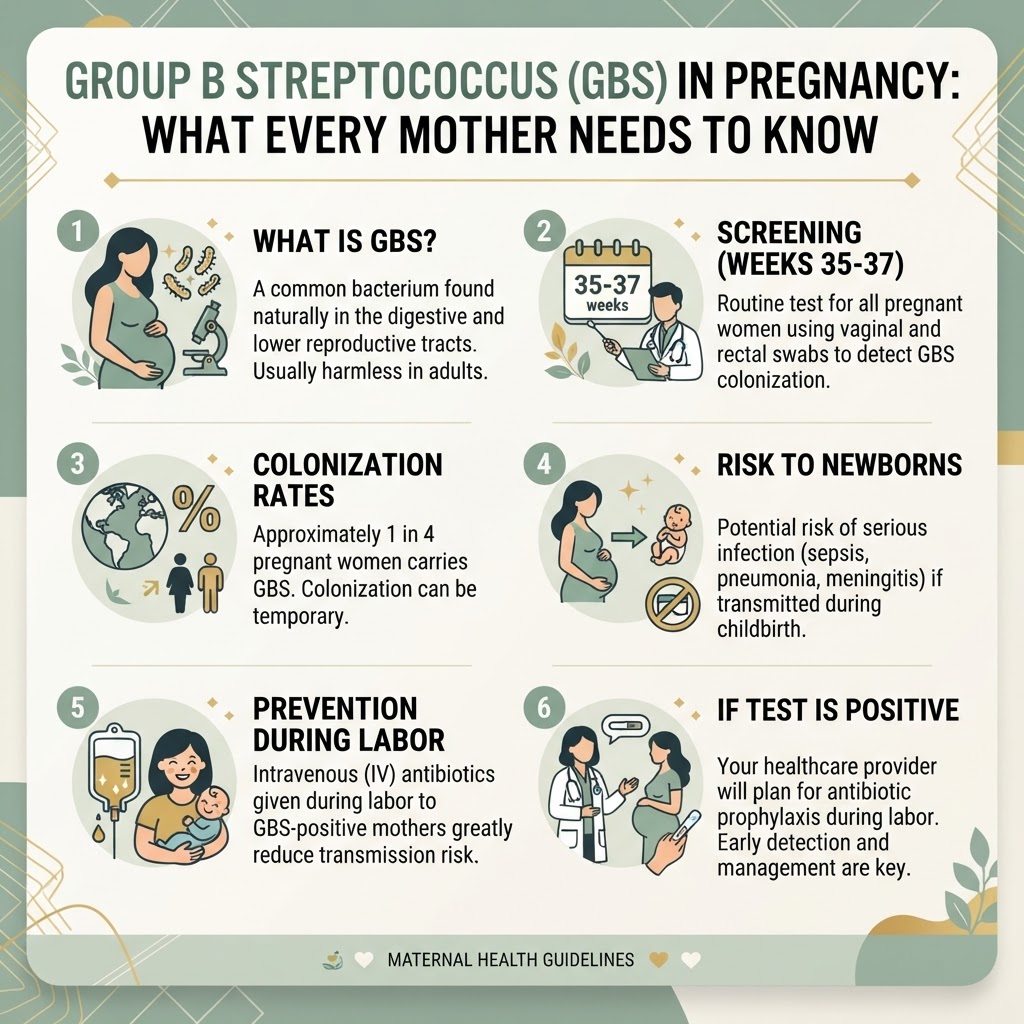
You're not alone. Every year, approximately 1 in 4 pregnant women in the UK and US carry Group B Streptococcus (GBS) — a bacterium that, while completely harmless to the mother in most cases, can pose serious risks to a newborn during labour and delivery. In fact, GBS is the leading cause of life-threatening infection in newborns in many high-income countries, according to the World Health Organization.
And yet, despite how common it is, GBS in pregnancy remains one of the most misunderstood and under-discussed topics in antenatal care.
This article is here to change that.
As a physician and founder of PregBiotics, I've made it my mission to bridge the gap between cutting-edge maternal science and the practical, empowering information every pregnant mother deserves. In this guide, we'll cover what GBS actually is, how it's detected, what it means for your birth plan, and — crucially — what you can do proactively to support your body's natural defences, including the science behind probiotics and our targeted GBS Shield Protocol.
Knowledge is your most powerful tool. Let's use it.
Understanding Group B Streptococcus: The Science Behind the Bacteria
What Is GBS?
Group B Streptococcus (Streptococcus agalactiae) is a gram-positive bacterium that naturally colonises the gastrointestinal and genitourinary tracts of healthy adults. It is not a sexually transmitted infection, nor is it something you "catch" through poor hygiene. It is simply part of the complex microbial landscape that exists within and around the human body.
For the vast majority of pregnant women, GBS colonisation causes no symptoms whatsoever. There is no rash, no odour, no discharge — nothing to indicate its presence. This is precisely why routine GBS screening in pregnancy is so critically important.
How Does GBS Become Dangerous?
The concern arises during labour and delivery. As a baby passes through the birth canal, they can be exposed to GBS bacteria. In most cases, this exposure is harmless — but in a subset of newborns, particularly those born prematurely or to mothers with prolonged rupture of membranes, the bacteria can overwhelm the infant's immature immune system, leading to:
- Early-onset GBS disease (within the first 7 days of life): typically manifesting as sepsis, pneumonia, or meningitis
- Late-onset GBS disease (between 7 days and 3 months): more commonly associated with meningitis and longer-term neurological complications
According to a landmark study published in The Lancet Infectious Diseases, an estimated 319,000 infant GBS cases occur globally each year, resulting in approximately 90,000 infant deaths and 10,000 cases of neurodevelopmental disability.
The Gut-Vaginal Microbiome Connection
Here is where the science becomes particularly fascinating — and where my work at PregBiotics is deeply rooted.
Research increasingly shows that GBS colonisation in the vaginal tract is closely connected to the health of the gut microbiome. GBS typically originates in the gut, migrating from the rectum to the vagina — which is why both sites are swabbed during GBS screening. Women with a depleted or dysbiotic gut microbiome — particularly those with low levels of Lactobacillus species — are significantly more likely to carry GBS at detectable levels.
This is not merely a coincidence. Lactobacillus strains produce lactic acid and hydrogen peroxide, creating an acidic vaginal environment that actively inhibits the colonisation and proliferation of pathogens like GBS. When this microbial defence is compromised — through stress, antibiotic use, poor diet, or hormonal changes in pregnancy — GBS can take hold more readily.
This biological insight forms the scientific foundation of targeted probiotic strategies for GBS prevention.
What GBS Means For You: Making the Science Practical
Understanding the biology is one thing — but what does a positive GBS result actually mean for your pregnancy? Let's bring this into real, practical terms.
GBS Screening: What to Expect
In the UK, routine GBS screening in pregnancy is not currently offered universally on the NHS (as of 2024), though this is an evolving area of policy. In the US, the CDC recommends universal screening between 35–37 weeks of gestation using a combined vaginal-rectal swab.
If you are in the UK and wish to be tested, you can:
- Request a test through your GP or midwife, though it may not always be available on the NHS
- Opt for private GBS testing, available from organisations like Group B Strep Support UK
- Ensure testing is done between 35–37 weeks for the most accurate result (results are reliable for approximately 5 weeks)
What Happens If You Test Positive?
A positive GBS result does not mean your baby will be harmed. It means your care team will take targeted precautions. Typically, this involves:
- Intrapartum antibiotic prophylaxis (IAP): IV antibiotics (usually penicillin) administered during labour to dramatically reduce the risk of passing GBS to your baby
- Closer monitoring during labour
- Observation of your newborn for signs of infection in the hours after birth
It's important to know that IAP is highly effective — it reduces the risk of early-onset GBS disease by up to 80%.
Key Points Every GBS-Positive Mother Should Know:
- A positive result does not mean you have an infection — it simply means the bacteria are present
- GBS status can change between pregnancies, so every pregnancy requires fresh testing
- Planned caesarean section (without labour onset or membrane rupture) significantly reduces transmission risk, though IAP may still be recommended
- Certain risk factors — preterm labour, fever in labour, prolonged rupture of membranes — increase the urgency of IAP regardless of your GBS status
- You have the right to ask questions and be fully involved in your care decisions
Understanding your GBS status empowers you to have informed, proactive conversations with your midwife or obstetrician. And while medical management is essential, there is also meaningful action you can take before your screening appointment to support your body's natural defences.
The Role of Nutrition, Gut Health, and Targeted Supplementation
This is the section I am most passionate about — because this is where you have agency.
While antibiotics remain the gold-standard medical intervention for GBS-positive mothers during labour, there is a growing and compelling body of research around the role of the maternal microbiome in reducing the likelihood of significant GBS colonisation in the first place. Prevention, as always, is more powerful than cure.
Diet as a Foundation
A gut-supportive diet during pregnancy creates the conditions for a flourishing Lactobacillus-dominant microbiome. This means:
- Increasing fermented foods: live yoghurt, kefir, sauerkraut, kimchi (pasteurised during pregnancy), miso
- Prioritising prebiotic fibre: garlic, onions, leeks, asparagus, oats, bananas — these feed beneficial bacteria
- Reducing ultra-processed foods and refined sugars: these fuel dysbiotic, pro-inflammatory bacteria
- Staying hydrated: supports mucosal immunity throughout the gut and vaginal tract
The Science of Probiotics and GBS
Multiple peer-reviewed studies have examined whether specific probiotic strains can reduce GBS colonisation. A 2020 systematic review published in NCBI/PubMed found that Lactobacillus rhamnosus and Lactobacillus reuteri supplementation was associated with reduced GBS colonisation rates and improved vaginal microbiome composition in pregnant women.
The proposed mechanisms are multi-layered:
- Competitive exclusion: beneficial bacteria crowd out pathogenic species for binding sites
- Bacteriocin production: antimicrobial compounds released by Lactobacillus strains directly inhibit GBS growth
- pH reduction: lactic acid production creates a hostile environment for GBS
- Immune modulation: probiotics enhance mucosal immune responses, making it harder for GBS to establish a foothold
Introducing the GBS Shield Protocol
This is precisely why we developed the GBS Shield Protocol at PregBiotics — a targeted, trimester-specific supplementation programme designed to support the maternal microbiome during the critical window before GBS screening.
The GBS Shield Protocol is built around the following evidence-informed components:
- Lactobacillus rhamnosus GR-1 — extensively studied for vaginal microbiome restoration and GBS inhibition
- Lactobacillus reuteri RC-14 — shown to reduce colonisation of pathogenic bacteria in the genitourinary tract
- Lactobacillus crispatus — the dominant species in a healthy, GBS-resistant vaginal microbiome
- Vitamin D3 — immune-regulating, with research linking deficiency to higher GBS colonisation rates
- Vitamin C — supports mucosal barrier integrity and immune readiness
- Prebiotic FOS (fructooligosaccharides) — nourishes the probiotic strains for maximum colonisation efficacy
Ideally, the GBS Shield Protocol is begun in the second trimester — giving the microbiome sufficient time to rebalance before the 35–37 week screening window. It is designed to complement, never replace, conventional medical care.
Expert Tips and Actionable Advice for Every Pregnant Mother
Whether you've just received a positive GBS result, are approaching your screening window, or are earlier in your pregnancy and want to be proactive, here is my practical, evidence-based guidance:
-
Start gut health support early. The second trimester is the ideal time to begin a targeted probiotic programme. Don't wait until 35 weeks — the microbiome takes time to shift meaningfully.
-
Request GBS screening proactively. If you're in the UK and universal testing isn't offered, advocate for yourself. Ask your midwife or GP, or consider private testing. Knowledge of your status allows for proper birth planning.
-
Discuss your birth plan in light of GBS. If you test positive, have an honest conversation with your care team about intrapartum antibiotics, monitoring preferences, and what to expect. Bring a partner or advocate to that appointment.
-
Understand your risk factors. GBS risk is heightened if you have a previous baby affected by GBS, preterm labour, fever in labour, or prolonged membrane rupture. Make sure your care team is aware of your history.
-
Don't skip the antibiotics if recommended. I know many mothers are understandably cautious about antibiotic use during pregnancy and labour. But IAP is targeted, short-duration, and the evidence for its benefit is overwhelming. If your care team recommends it, please take it — and follow with a postnatal probiotic course to support microbiome recovery for both you and your baby.
-
Support your immune system holistically. Sleep, stress reduction, nutrient-dense eating, and appropriate supplementation all contribute to a more resilient microbiome and immune response. Pregnancy is demanding — protect your reserves.
-
Stay informed. Download the Pregnancy Gut Guide from PregBiotics for a trimester-by-trimester breakdown of how to support your microbiome throughout your entire pregnancy journey.
-
Postnatally, consider probiotic drops for your newborn. If you were GBS-positive and received IAP, the antibiotics can impact your baby's developing gut microbiome. Infant-specific probiotic drops (under paediatric guidance) may support healthy early colonisation.
When to Seek Medical Advice
While much of what I've shared in this article is about proactive, empowering steps you can take, I want to be unequivocally clear: GBS in pregnancy is a medical matter that requires professional oversight.
Please seek immediate medical attention if you experience any of the following during pregnancy or postpartum:
- Signs of urinary tract infection (burning urination, frequency, fever) — GBS can cause UTIs in pregnant women that require antibiotic treatment
- Fever, chills, or flu-like symptoms in labour
- Your waters break before 37 weeks, or more than 18 hours before labour begins
- Any signs of infection in your newborn: fever, poor feeding, unusual irritability, rapid breathing, or a bulging fontanelle
Always discuss any supplementation — including probiotics — with your midwife, GP, or obstetrician before beginning, particularly if you have a high-risk pregnancy, allergies, or are taking other medications.
The information in this article is educational and science-informed, but it does not replace personalised medical advice. Your care team knows your individual history — work with them, not around them.
Conclusion: You Are More Empowered Than You Know
Group B Streptococcus in pregnancy is common, often symptomless, and — when properly identified and managed — something that the vast majority of mothers and babies navigate safely. But navigating it safely requires awareness, proactive screening, and a genuine understanding of how your body works.
What I hope you take from this article is not anxiety, but agency.
You now understand what GBS is, why the gut-vaginal microbiome axis matters, why GBS screening in pregnancy is so important, and how targeted strategies — from a gut-supportive diet to the GBS Shield Protocol — can work alongside conventional medical care to give your baby the healthiest possible start.
The science of maternal gut health is young, exciting, and rapidly evolving — and at PregBiotics, we are committed to translating that science into tools you can actually use.
If you found this article valuable, I'd encourage you to explore more evidence-based maternal health content at The PregBiotics Journal, where we publish in-depth guides on everything from pregnancy nutrition to postnatal microbiome recovery.
You are not powerless in this journey. You are informed, you are prepared, and you are exactly the kind of mother your baby needs.
With care and science, Dr. Chomba Chuma, MD Founder, PregBiotics
Disclaimer: This article is for educational purposes only and does not constitute medical advice. Always consult your healthcare provider regarding your individual pregnancy care.
Get the PregBiotics Journal in your inbox
Gut-smart guidance for conception, pregnancy and breastfeeding — twice a week, plus member-only offers. Unsubscribe anytime.
You deserve to feel beautifully supported.
Join thousands of mothers on the PregBiotics journey. Receive your free Pregnancy Prep Guide and gentle, science-backed wisdom — tailored to where you are right now.