Group B Streptococcus in Pregnancy: What Every Mother Needs to Know About GBS Screening, Risk, and Prevention
Imagine you're 36 weeks pregnant, glowing with anticipation, when your midwife mentions a routine swab test for something called Group B Strep. You nod along, but later that evening you find yourself down a rabbit hole of medical websites, wondering what this bacteria actually means for you and your
Dr. Chomba Chuma, MD & Founder
MD & Founder, PregBiotics

Group B Streptococcus in Pregnancy: What Every Mother Needs to Know About GBS Screening, Risk, and Prevention
By Dr. Chomba Chuma, MD & Founder | PregBiotics Journal
Introduction
Imagine you're 36 weeks pregnant, glowing with anticipation, when your midwife mentions a routine swab test for something called Group B Strep. You nod along, but later that evening you find yourself down a rabbit hole of medical websites, wondering what this bacteria actually means for you and your baby. You're not alone — and you deserve clear, honest answers.
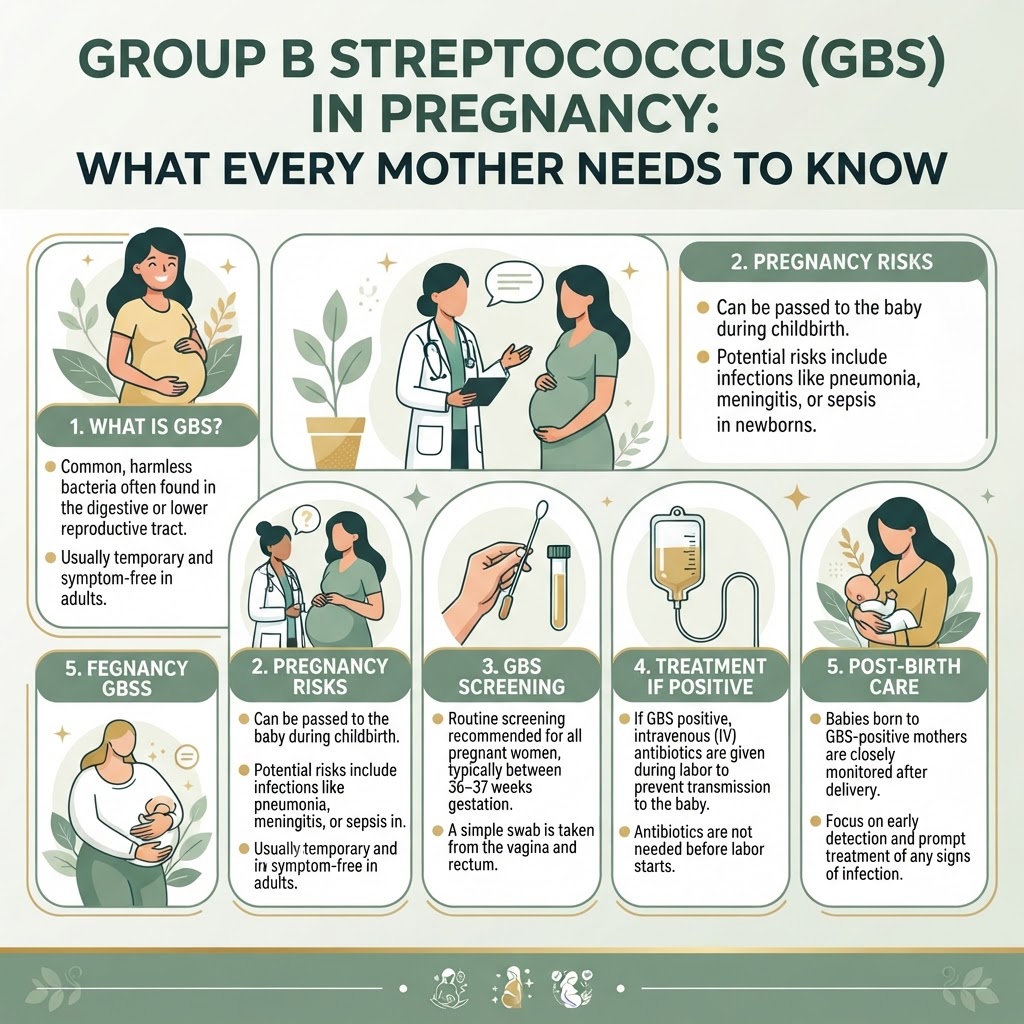
Here's a statistic that often surprises expectant mothers: Group B Streptococcus (GBS) naturally colonises the gut and vaginal tract of approximately 10–30% of pregnant women worldwide, yet the vast majority have no idea they carry it. In most healthy adults, GBS causes no symptoms and no harm. But during pregnancy and birth, this otherwise quiet bacterium can pose serious risks to newborns — including sepsis, meningitis, and pneumonia in the first days of life.
The good news? GBS pregnancy management has advanced enormously. With the right screening, the right care team, and — as emerging science now suggests — the right approach to your gut microbiome, you have real tools to protect yourself and your baby.
In this article, I'll walk you through everything you need to know about GBS in pregnancy: what it is, how GBS screening in pregnancy works, what the current medical guidelines recommend, and how evidence-backed nutritional strategies — including targeted probiotic support through our GBS Shield — can play a meaningful role in your maternal health journey.
Let's start from the beginning.
Understanding Group B Streptococcus: The Science Behind the Bacteria
What Is GBS?
Group B Streptococcus, formally known as Streptococcus agalactiae, is a gram-positive bacterium that lives naturally in the gastrointestinal and genitourinary tracts of healthy humans. It is not a sexually transmitted infection, it is not caused by poor hygiene, and carrying it says nothing negative about your health choices. It is simply part of the microbial landscape that some people carry — transiently or persistently.
What makes GBS clinically significant in pregnancy is the risk of vertical transmission — the passing of bacteria from mother to baby during labour and birth, particularly as the baby passes through the birth canal. Newborns have immature immune systems, making them far more vulnerable to invasive GBS infection than adults.
How Common Is GBS Infection in Newborns?
According to the World Health Organization, GBS is one of the leading causes of life-threatening infections in newborns globally, responsible for an estimated 390,000 infant infections and 90,000 newborn deaths annually. In the UK and US, neonatal GBS disease affects roughly 1–2 in every 1,000 live births, with early-onset disease (within the first 7 days of life) being the most serious presentation.
The Gut-Vaginal Microbiome Connection
Here is where the science becomes particularly fascinating — and directly relevant to why gut health matters in GBS pregnancy management.
GBS colonisation does not occur in isolation. It exists within the broader ecosystem of the gut and vaginal microbiome. Research published in Frontiers in Microbiology has demonstrated that a diverse, lactobacillus-dominant vaginal microbiome is strongly associated with reduced GBS colonisation rates. Conversely, dysbiosis — an imbalance in the microbial community — creates an environment where GBS can more readily establish and persist.
The gut microbiome plays a critical upstream role here. Because the GI tract is the primary reservoir for GBS, the composition of your gut flora directly influences vaginal colonisation patterns. This bidirectional gut-vaginal axis is now an active area of maternal health research, and it underpins the rationale for microbiome-targeted interventions in pregnancy.
Risk Factors for GBS Colonisation and Transmission
While any pregnant woman can carry GBS, certain factors are associated with higher risk of neonatal disease:
- Previous baby affected by GBS (significantly elevates risk in subsequent pregnancies)
- GBS detected in urine during pregnancy (bacteriuria)
- Preterm labour (before 37 weeks)
- Prolonged rupture of membranes (more than 18 hours before delivery)
- Fever during labour
- Multiple pregnancy
Understanding your personal risk profile is the first step toward informed, proactive care.
What GBS in Pregnancy Means for You: Practical Realities
GBS Screening in Pregnancy: Know Your Options
GBS screening in pregnancy varies significantly by country, and this inconsistency can be a source of confusion and frustration for mothers.
In the United States, universal GBS screening is standard practice. The Centers for Disease Control and Prevention (CDC) recommend a rectovaginal swab between 35–37 weeks of gestation, with intrapartum antibiotic prophylaxis (IAP) offered to all women who test positive.
In the United Kingdom, the approach differs. The NHS does not currently offer routine universal GBS screening, instead relying on risk-factor-based assessment. However, private testing is available and widely used, and many maternity advocates — including charities like Group B Strep Support — actively campaign for universal screening to be adopted.
In Australia and Canada, guidelines similarly vary by region, with a mix of universal and risk-based approaches.
What does this mean for you practically?
- Ask your midwife or obstetrician directly about GBS testing policy in your area
- Know that you can request private screening if universal testing is not offered in your country
- Understand that a negative test at 35–37 weeks does not guarantee GBS-negative status at delivery, as colonisation can change
- If you have known risk factors, discuss them explicitly with your care team — you may qualify for prophylactic antibiotics regardless of swab result
If You Test GBS Positive: What Happens Next
A positive GBS result can feel alarming, but it is important to hold this in perspective. The vast majority of GBS-positive mothers give birth to healthy babies. The primary intervention — intravenous antibiotics during labour — is highly effective at preventing early-onset neonatal GBS disease, reducing risk by approximately 80%.
Key points if you test positive:
- Inform your hospital or birth centre so they can prepare intrapartum antibiotics (typically penicillin)
- Go to hospital promptly when labour begins or waters break, so antibiotics can be administered in time
- Discuss any penicillin allergy with your provider well in advance — alternative antibiotics are available
- Understand that caesarean section before labour and membrane rupture carries lower GBS transmission risk, though this is not performed solely for GBS reasons
- Breastfeeding is safe — GBS is not a contraindication to breastfeeding
The Role of Nutrition, the Gut Microbiome, and Targeted Supplementation
This is the section I am most passionate about sharing with you, because it represents a frontier that many conventional maternity guidelines have not yet fully incorporated — but the science is genuinely compelling.
Why Your Microbiome Matters More Than You Think
We now understand that the maternal gut microbiome undergoes significant changes throughout pregnancy — and that these changes have downstream effects on vaginal flora, immune function, and even placental health. A well-nourished, diverse gut microbiome is not a luxury. For GBS management, it may be a meaningful protective factor.
Several clinical studies have examined the role of Lactobacillus species in reducing GBS colonisation:
- A study in the Journal of Maternal-Fetal & Neonatal Medicine found that vaginal lactobacillus dominance was inversely associated with GBS presence
- Animal and in vitro studies have demonstrated that specific Lactobacillus strains can inhibit GBS adherence and biofilm formation through competitive exclusion and bacteriocin production
- Research published on NCBI suggests that probiotic interventions targeting the gut-vaginal axis show promise in modulating GBS colonisation, though larger clinical trials are ongoing
This is precisely the scientific foundation upon which our GBS Shield Protocol has been developed.
Introducing the GBS Shield Protocol
The GBS Shield Protocol is PregBiotics' most targeted formulation — designed specifically to support the gut-vaginal microbiome ecosystem during the third trimester and in the lead-up to birth. It is not a replacement for medical screening or intrapartum antibiotics. It is a complementary, science-informed strategy to optimise your microbial environment from the inside out.
Key strains and nutrients in the GBS Shield Protocol include:
- Lactobacillus rhamnosus GR-1 — one of the most clinically studied strains for vaginal microbiome health; shown to reduce pathogenic colonisation
- Lactobacillus reuteri RC-14 — works synergistically with GR-1 to support lactobacillus dominance in the vaginal environment
- Lactobacillus crispatus — the dominant species in a healthy, protective vaginal microbiome
- Bifidobacterium longum BB536 — supports gut immune modulation and reduces systemic inflammatory load
- Vitamin D3 (2000 IU) — critical for innate immune function; deficiency is associated with increased susceptibility to bacterial infections in pregnancy
- Zinc bisglycinate — supports mucosal immune barriers and epithelial integrity
- Prebiotic FOS blend — feeds and sustains beneficial bacteria in the gut, amplifying probiotic efficacy
For broader gut health support throughout pregnancy, our PregBiotics Essentials formula provides foundational microbiome nourishment that complements the GBS Shield Protocol beautifully.
Dietary Strategies to Support Your Microbiome
Beyond supplementation, daily food choices matter:
- Fermented foods (kefir, live yoghurt, kimchi, sauerkraut) introduce beneficial bacteria naturally
- High-fibre vegetables and legumes feed beneficial gut bacteria and reduce dysbiosis
- Reduce ultra-processed foods and excess sugar, which promote overgrowth of pathogenic organisms
- Stay well hydrated — mucosal health depends on adequate fluid intake
- Limit unnecessary antibiotic exposure prior to pregnancy where possible, as antibiotics significantly disrupt gut flora diversity
Expert Tips and Actionable Advice for GBS Pregnancy Management
After years of working with pregnant mothers, here are the evidence-informed steps I recommend to every woman navigating GBS in pregnancy:
-
Know your country's screening policy early — ask about GBS testing at your booking appointment (ideally before 16 weeks) so you have time to plan
-
Request a rectovaginal swab at 35–37 weeks if you are in a country without universal screening — private testing is widely available and affordable
-
Start microbiome support early — ideally from the second trimester, not just when a positive result comes back. The gut-vaginal microbiome takes time to shift
-
Begin the GBS Shield Protocol by 28–30 weeks to give the strains adequate time to colonise and modulate your microbial environment before the critical screening window
-
Discuss your birth plan with your care team including hospital arrival timing if GBS positive, antibiotic preferences, and newborn monitoring protocols
-
Do not douche or use antiseptic vaginal washes — these disrupt the very lactobacillus-dominant environment you want to maintain
-
Tell every healthcare provider involved in your birth about your GBS status — include it in your birth preferences document
-
If you receive intrapartum antibiotics, consider a postnatal probiotic protocol for both yourself and your baby to support microbiome recovery — and discuss this with your paediatrician
-
Breastfeed if you are able — human milk contains a rich array of probiotic organisms and prebiotics that seed and nourish your baby's developing microbiome, which may offer some immune protection
-
Stay informed, not alarmed — GBS is manageable. Knowledge is your greatest asset, and you are not navigating this alone
When to Seek Medical Advice
While this article provides educational information, I want to be absolutely clear: GBS management in pregnancy requires individualised medical care from a qualified healthcare provider. Please do not rely solely on this article or any supplement to manage your GBS risk.
Seek prompt medical attention if:
- You experience painful urination, unusual discharge, or pelvic pressure — these may indicate GBS urinary tract infection, which requires antibiotic treatment regardless of gestational age
- You are GBS positive and go into preterm labour (before 37 weeks) — contact your maternity unit immediately
- Your waters break before labour begins and you are GBS positive — do not wait at home; go to hospital promptly
- Your newborn shows any signs of infection in the first weeks of life — fever, poor feeding, unusual drowsiness, or breathing difficulties require urgent assessment
If you have any concerns about GBS screening, results, or management, speak openly with your midwife, obstetrician, or GP. Every pregnancy is unique, and personalised guidance from your care team is irreplaceable. The PregBiotics GBS Shield Protocol is designed to complement — never replace — evidence-based medical care.
Conclusion: You Are More Empowered Than You Know
Group B Streptococcus is one of those topics that sounds frightening at first but becomes far less daunting when you understand it fully. The vast majority of GBS-positive pregnancies result in healthy, thriving babies — especially when mothers are informed, screened appropriately, and supported by good care.
What excites me most, as both a physician and the founder of PregBiotics, is the emerging science around the gut-vaginal microbiome axis. We are entering an era where maternal gut health is recognised not just as a digestive issue, but as a fundamental pillar of pregnancy safety, immune resilience, and neonatal wellbeing. The GBS Shield Protocol was built on this science — to give mothers a meaningful, evidence-informed tool alongside their conventional care.
To recap the key takeaways from this article:
- GBS naturally colonises 10–30% of pregnant women and requires proactive screening
- GBS screening in pregnancy policies vary by country — know yours and advocate for testing
- Intrapartum antibiotics are highly effective and remain the gold standard for GBS-positive mothers
- A lactobacillus-dominant gut and vaginal microbiome is associated with lower GBS colonisation risk
- Targeted probiotic supplementation through the GBS Shield Protocol, alongside a nutrient-rich diet, supports your body's microbial defences during this critical window
- Always work with your healthcare team — information and supplementation empower, but they do not replace personalised medical guidance
You are not helpless in the face of GBS. You are informed, proactive, and supported. For more evidence-based maternal health reading, explore The PregBiotics Journal — where science meets the real experience of pregnancy.
With warmth and clinical care,
Dr. Chomba Chuma, MD Founder, PregBiotics
This article is for informational and educational purposes only. It does not constitute medical advice. Always consult your qualified healthcare provider for guidance specific to your pregnancy.
Get the PregBiotics Journal in your inbox
Gut-smart guidance for conception, pregnancy and breastfeeding — twice a week, plus member-only offers. Unsubscribe anytime.
You deserve to feel beautifully supported.
Join thousands of mothers on the PregBiotics journey. Receive your free Pregnancy Prep Guide and gentle, science-backed wisdom — tailored to where you are right now.