
How to Prepare Your Body for Pregnancy Naturally: A Whole-Body Guide
Learn how to prepare your body for pregnancy naturally with evidence-informed steps for sleep, stress, blood sugar, movement and gut health.
Dr. Chomba Chuma, MD & Founder
MD & Founder, PregBiotics
How to prepare your body for pregnancy naturally is a question I hear often in my consulting room, usually from women who have already taken folic acid and booked their first scan, yet still feel something is missing. The truth is that preparing your body for pregnancy is not a single checklist item — it is a whole-body process that unfolds over weeks and months, touching your hormones, your blood sugar, your sleep, and your gut. This article looks at that bigger picture, beyond supplements alone.
How to Prepare Your Body for Pregnancy Naturally: Beyond the Checklist
Many women assume that preparing for pregnancy simply means starting a prenatal vitamin and cutting out alcohol. Those steps matter, but they are only part of the story.
Your body is a network of interconnected systems — hormonal, metabolic, immune and digestive — and each one influences your readiness to conceive and carry a healthy pregnancy. The World Health Organization frames this period as a genuine opportunity, not just a formality before conception.
"Preconception care offers a critical opportunity to identify and modify biomedical, behavioural, and social risks to a woman's health and pregnancy outcome." — WHO, Preconception Care Policy Brief
This is why we encourage mothers to think in terms of systems, not just supplements. If you have already worked through nutrient basics, our article on the essential nutrients every woman should optimise before trying to conceive is a useful companion to this one.
Your Hormonal Rhythm Comes First
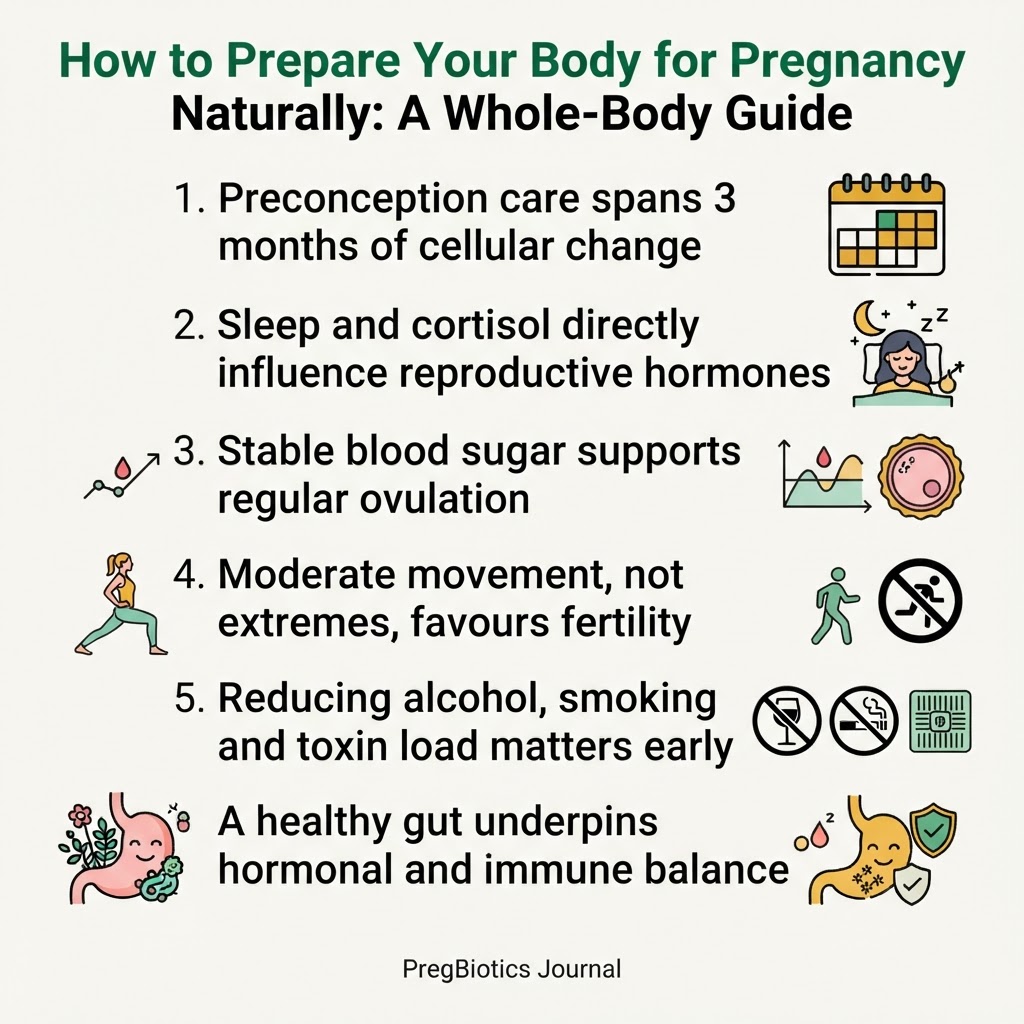
Ovulation depends on a finely tuned hormonal cascade, and that cascade is highly sensitive to sleep and stress. Chronic short sleep and elevated cortisol are associated with disrupted luteinising hormone pulses, which can affect cycle regularity.
Practical ways to support this rhythm include:
- Keeping a consistent sleep and wake time, even on weekends
- Limiting screens for 30–60 minutes before bed
- Building in short daily stress-release practices — walking, breathing exercises, journaling
- Avoiding chronic under-eating, which can suppress reproductive hormones
None of these steps guarantee a particular outcome, but they are consistently associated with more stable cycles and may help your body respond more predictably once you begin trying to conceive.
Blood Sugar Balance: The Quiet Foundation
Insulin and reproductive hormones are closely linked. When blood sugar swings widely across the day, insulin resistance can develop over time, and this is associated with irregular ovulation in some women, particularly those with PCOS-type patterns.
Simple, sustainable habits here include:
- Pairing carbohydrates with protein or fibre at each meal
- Avoiding long gaps without eating, which can trigger blood sugar crashes
- Choosing minimally processed starches where possible
- Moving after meals, even a 10-minute walk
If you want a deeper, food-first approach to this topic, our guide on what to eat when trying to conceive walks through practical meal patterns in more detail.
Movement That Supports, Not Depletes
Exercise is protective for cardiovascular and metabolic health, but more is not always better when preparing your body for pregnancy. Very high-intensity or high-volume training, especially alongside low energy intake, can suppress ovulatory function in some women.
A balanced approach generally includes:
- 150 minutes of moderate activity across the week, as suggested by most national guidelines
- Strength training two to three times weekly to support metabolic health
- Rest days that are genuinely restful, not just lower-intensity cardio
The goal is a body that feels resourced, not depleted, heading into conception.
Reducing the Load: Alcohol, Smoking and Everyday Toxins
Preconception preparation is also about reducing unnecessary burdens on your body's detoxification and immune systems. Alcohol and tobacco use are well-documented factors associated with reduced fertility and less favourable pregnancy outcomes.
"Health before pregnancy — including nutrition, weight, chronic disease management, and avoidance of harmful substances — directly influences maternal and infant outcomes." — Centers for Disease Control and Prevention, Preconception Health guidance
Beyond the obvious, many women do not realise how everyday exposures add up: excess caffeine, certain plastics in food storage, and some personal care product ingredients. You cannot eliminate every exposure, and that is not the goal. Small, consistent reductions over the months before conception are what matter most.
For broader reading on this, the CDC's preconception health resources (https://www.cdc.gov/preconception/index.html) and the ACOG patient guidance on prepregnancy care (https://www.acog.org/womens-health/faqs/good-health-before-pregnancy-prepregnancy-care) are both solid, accessible starting points.
How to Prepare Your Body for Pregnancy Naturally in a Simple 12-Week Rhythm
Rather than trying to change everything overnight, many of my patients find it easier to think in a loose 12-week rhythm. This mirrors the approximate time it takes for an egg to mature from its earliest stage to ovulation, which is one reason preconception specialists often recommend starting changes around three months ahead.
Weeks 1–4: Stabilise the basics
- Set a consistent sleep schedule
- Begin a prenatal vitamin if you haven't already, after discussing it with your healthcare provider
- Reduce alcohol and tobacco exposure
Weeks 5–8: Build metabolic resilience
- Introduce regular, moderate movement
- Focus meals around protein, fibre and healthy fats to stabilise blood sugar
- Address any ongoing digestive symptoms, since gut comfort often reflects deeper hormonal and immune balance
Weeks 9–12: Fine-tune and review
- Revisit your checklist with your healthcare provider, including any screening tests
- Reassess stress levels and sleep quality
- Consider targeted support, such as a gut-focused probiotic formulated for preconception, as part of a broader plan
If you'd like a more structured version of this timeline, our preconception checklist for the three months before trying to conceive lays out specific tasks week by week.
The Gut's Quiet Role in This Process
It would be incomplete to talk about whole-body preparation without mentioning the gut, even briefly. A balanced gut microbiome is involved in immune regulation, nutrient absorption, and even some hormone metabolism pathways, including oestrogen recycling.
This does not mean the gut is the only factor, but it is one more piece of a body that is working as an integrated system rather than a collection of separate parts. Many mothers find that addressing digestive comfort alongside sleep, stress and blood sugar creates a more noticeable sense of readiness heading into conception.
When to Loop in Your Healthcare Provider
Natural preparation works best alongside clinical guidance, not instead of it. Speak to your healthcare provider about:
- Any irregular cycles, as these may need specific investigation
- Existing conditions such as thyroid disorders, diabetes, or autoimmune disease
- Current medications and whether any need review before conception
- Appropriate screening and blood tests for your personal history
Your provider can also advise on the right timing for any supplements, including when to start and which formulations suit your individual needs.
Your Simplest First Step
If all of this feels like a lot, start with one thing: protect your sleep this week, and pair it with one gut-friendly habit, such as a daily source of fibre or a quality probiotic formulated for the preconception window. Our PregBiotics Conception formula was developed with exactly this stage in mind, supporting gut and vaginal microbiome balance as part of your broader preparation.
From there, build outward — blood sugar, movement, and reduced toxin load — at a pace that feels sustainable rather than overwhelming. For more practical, evidence-informed guidance like this, subscribe to the PregBiotics Journal and we'll walk this road with you, one trimester-sized step at a time.
Get the PregBiotics Journal in your inbox
Gut-smart guidance for conception, pregnancy and breastfeeding — twice a week, plus member-only offers. Unsubscribe anytime.
You deserve to feel beautifully supported.
Join thousands of mothers on the PregBiotics journey. Receive your free Pregnancy Prep Guide and gentle, science-backed wisdom — tailored to where you are right now.