PregBiotics Ingredients and Strains: A Mother's Label-Reading Guide
Learn how to decode PregBiotics ingredients and strains, understand CFU counts, and choose a pregnancy-safe probiotic with confidence in South Africa.
Dr. Chomba Chuma, MD & Founder
MD & Founder, PregBiotics

When you turn a probiotic bottle around and read the label, do you actually understand what you're looking at? Understanding PregBiotics ingredients and strains isn't about memorising Latin names — it's about knowing enough to ask your healthcare provider the right questions and make an informed choice for yourself and your baby. In South Africa, where the supplement market is growing faster than regulation can keep pace, this knowledge is protective, not just interesting.
Most mothers assume all probiotics are essentially the same — a jar of 'good bacteria' that does good things. But the research tells a very different story, and it matters enormously when you're pregnant, trying to conceive, or breastfeeding.
Why "Probiotic" Isn't Enough: Understanding PregBiotics Ingredients and Strains
A probiotic label typically lists a genus (like Lactobacillus), a species (like rhamnosus), and — if the manufacturer is being transparent — a strain code (like GG or HN001). Each level narrows down exactly what you're taking.
This distinction isn't academic. Two strains within the same species can behave completely differently in the body. One might support gut comfort during pregnancy; another, closely related strain might do nothing measurable at all.
"Probiotic effects are strain-specific; no single strain's benefits can be assumed to extend to another strain, even within the same species." — Hill et al., ISAPP Consensus Statement, 2014
This is precisely why reading PregBiotics ingredients and strains carefully — rather than trusting a generic "probiotic" label — should be part of every mother's decision-making process. For a broader look at how pregnancy reshapes your microbiome, our earlier article Why Your Gut Health Changes Dramatically During Pregnancy offers helpful context.
The Strain-Specificity Principle: What the Science Actually Shows
Research on probiotics during pregnancy and lactation has focused on a relatively small, well-studied set of strains. These are the strains with published human trials, documented safety records, and known mechanisms of action — not simply bacteria that sound beneficial.
Some of the most researched strains in maternal health include:
- Lactobacillus rhamnosus GG — one of the most studied probiotic strains globally, with decades of safety data
- Lactobacillus rhamnosus HN001 — studied specifically in pregnant and breastfeeding populations
- Lactobacillus reuteri (various documented strains) — associated with gut comfort and infant microbiome considerations
- Bifidobacterium lactis — commonly found in the infant gut and studied for maternal-to-baby transfer
The US National Center for Complementary and Integrative Health offers a useful plain-language overview of how probiotic research is evaluated, which is worth bookmarking if you want to go deeper: NCCIH, Probiotics: What You Need to Know.
The key takeaway: a formula built around documented, named strains is fundamentally different from one that simply lists "probiotic blend" on the back.
Core PregBiotics Ingredients and Strains Explained
Let's break down what these ingredient categories are actually doing, in plain terms.
Lactobacillus species
These strains are naturally abundant in a healthy vaginal and gut microbiome. During pregnancy, Lactobacillus populations often shift, and research has explored how targeted strains may support this balance. If you're curious about the vaginal microbiome specifically, we've covered that in The Vaginal Microbiome: A Hidden Key to Successful Implantation.
Bifidobacterium species
These strains dominate the infant gut and are associated with the handoff of maternal microbiota during birth and breastfeeding. Their presence in a maternal formula is generally included with this transfer in mind, supporting the groundwork for your baby's developing microbiome.
Prebiotic fibres and cofactors
Prebiotics such as galacto-oligosaccharides (GOS) and fructo-oligosaccharides (FOS) are non-digestible fibres that feed beneficial bacteria already present in your gut. Think of probiotics as the seeds and prebiotics as the fertiliser — one without the other is a less complete strategy.
"The scope and appropriate use of the term 'probiotic' depends entirely on strain-level evidence, dose, and the health outcome being studied." — International Scientific Association for Probiotics and Prebiotics (ISAPP)
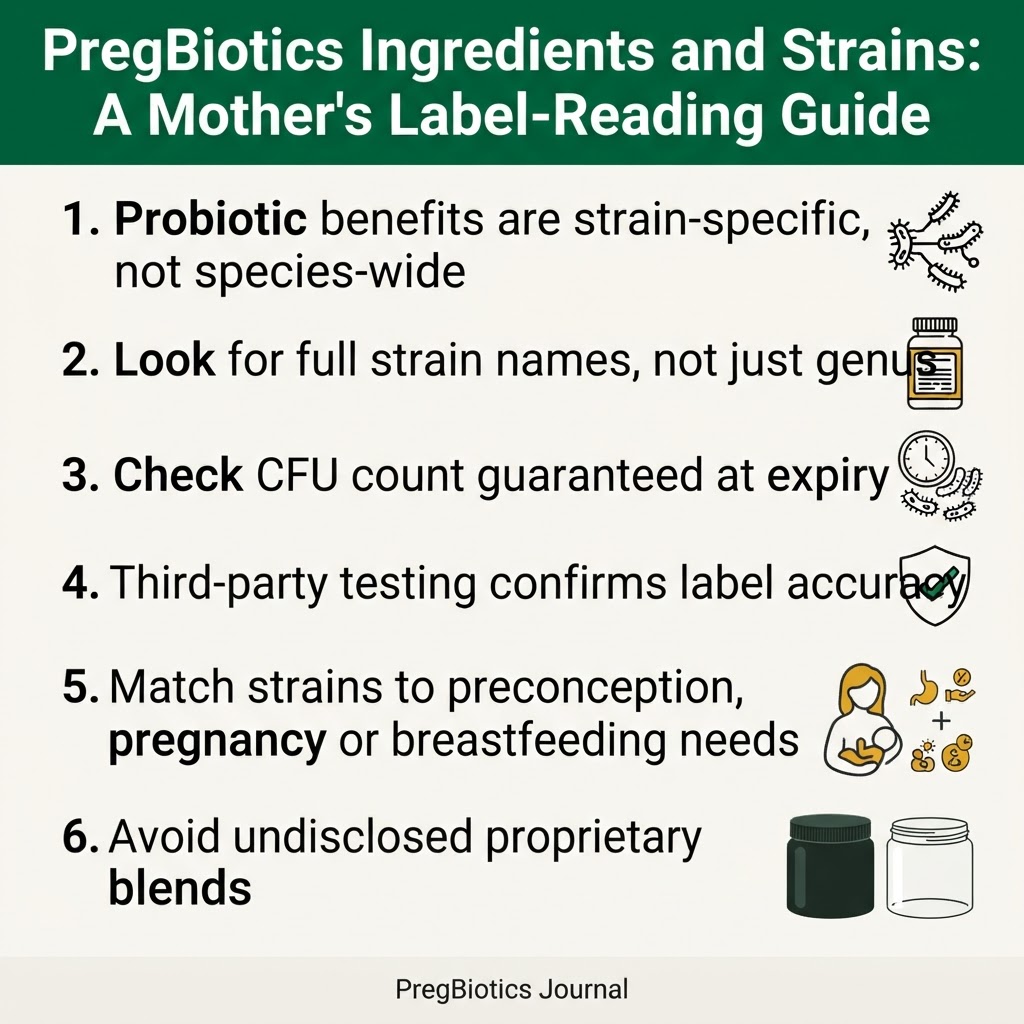
How to Read a Probiotic Label Like a Clinician
Once you understand strains, the label itself becomes much easier to evaluate. Here's what to look for:
- Full strain designation — genus, species, and strain code (not just "Lactobacillus blend")
- CFU count guaranteed through expiry, not just at the time of manufacture
- Third-party testing or certification confirming the label matches the contents
- Delivery technology — some capsules are designed to survive stomach acid so the strains reach the gut alive
- Transparent sourcing and manufacturing standards, ideally compliant with recognised quality frameworks
If a product won't tell you exactly which strains it contains, that's a meaningful gap — not a minor detail. Our checklist article, Where to Buy PregBiotics: A Mother's Safety Checklist for Probiotics, expands on sourcing and verification in more depth.
Matching PregBiotics Ingredients and Strains to Your Stage of Motherhood
Your needs shift across preconception, pregnancy, and breastfeeding — and ingredient priorities should shift with you.
Preconception: Strain selection here often centres on supporting vaginal and gut microbial balance ahead of conception, a topic we explore in How Your Gut Microbiome Affects Fertility and Your Ability to Conceive.
Pregnancy: As your body changes, gut comfort becomes a bigger focus, alongside awareness of Group B Streptococcus colonisation — a topic covered extensively in our GBS screening and prevention guide.
Breastfeeding: Strains associated with the maternal-to-infant microbiome transfer become more relevant, which we discuss further in How Your Gut Microbiome Shapes Your Breast Milk.
In each case, speak to your healthcare provider about which strains are appropriate for your individual history, especially if you have underlying conditions or are taking other medication.
Red Flags: What Shouldn't Be in Your Prenatal Probiotic
Not every product marketed to expecting mothers has been designed with the same rigour. Watch for:
- "Proprietary blends" that hide individual strain amounts
- Exotic or unstudied strains with no published safety data in pregnancy
- Unnecessary added sugars or fillers, particularly in gummy formats
- No batch testing or certificate of analysis available on request
- Vague label language like "good bacteria" instead of named strains
The American College of Obstetricians and Gynecologists offers general guidance on supplement use during pregnancy that reinforces the importance of discussing any addition with your provider: ACOG, Nutrition During Pregnancy.
"Supplement decisions during pregnancy should always involve a conversation with your healthcare provider, particularly where product quality and dosing aren't independently verified." — adapted from maternal health guidance, SASOG
Your Simplest Next Step
You don't need to become a microbiologist to make a confident choice. Start by pulling out whatever probiotic you currently take — or are considering — and checking it against the label checklist above.
If you'd like a formula built around documented strains with transparent labelling for daily pregnancy support, explore PregBiotics Essentials and discuss it with your healthcare provider before starting.
And if you'd like more guidance like this delivered straight to you, subscribe to the PregBiotics Journal — we're here to help you read the label, ask the right questions, and feel confident in every choice you make for you and your baby.
Get the PregBiotics Journal in your inbox
Gut-smart guidance for conception, pregnancy and breastfeeding — twice a week, plus member-only offers. Unsubscribe anytime.
You deserve to feel beautifully supported.
Join thousands of mothers on the PregBiotics journey. Receive your free Pregnancy Prep Guide and gentle, science-backed wisdom — tailored to where you are right now.